Remotely.Local

Remotely.Local@remotelylocal

0 followers
Follow

Season 1 episodes (2)

Bringing AI to Burning Man Art with Kevin Clark of Reared In Steel
S01:E02

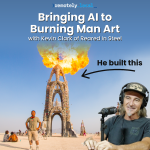
Bringing AI to Burning Man Art with Kevin Clark of Reared In Steel

Some of the most striking art on the playa is wired as much as it’s welded. On this episode of Remotely Local, Ryo Koyama and Mike Johnson sit down with Kevin Clark, founder of Reared In Steel, whose fire sculptures have been lighting up Burning Man for more than a decade. His pieces range from the 26-snake Medusa to the 80-foot Flower Tower and the 110-effect, MIDI-controlled Fire Cathedral. Kevin tells how he got hooked on Burning Man in the early days of the temple movement, helping Jack Haye and David Best. He explains why scale matters when you’re building in the middle of the desert. Mike, who built the control systems behind the pieces, walks through how the tech grew from push buttons to Raspberry Pis, relay banks, MIDI, and remote access from the playa. That includes the night a stranger plugged in a homemade keytar and played the Fire Cathedral. They also get into Guma, the climbable Burning Man 2025 piece Kevin built with his daughter, including the story behind the viral bike crash. Kevin talks about teaching teenagers to weld, why he sees AI as a tool for getting ideas out faster rather than as the finished art, and why he’d happily put a few robot welders on the crew. Chapters 00:00 Intro 00:33 Mike and Kevin’s friendship and the naming of Reared In Steel 02:08 What Reared In Steel does and the early Burning Man builds 02:51 Burning Man temples and getting involved early on 05:23 How big these sculptures are and why scale matters 07:04 How the technology behind the art has evolved 08:23 Building the Fire Cathedral and its most unforgettable moments 12:51 AI as a tool for artists 17:58 Guma and how it became one of Burning Man’s most talked-about builds 23:16 What’s next for Reared In Steel’s technology 25:48 Why physical AI still needs hands-on skills like welding 31:24 What “physical AI” really means and the social media challenge 34:45 The AI hot take Links Watch the video version of this podcast (includes the crash clip): https://www.youtube.com/watch?v=QsIO-rHsD8o Reared In Steel on Facebook: https://www.facebook.com/rearedinsteel/ Guma dino crash video: https://www.youtube.com/watch?v=5HHFIPKMISc Remotely Local: https://remotelylocal.com

Bringing AI to Energy Management with Sam Cox of Mountain Vector Energy
S01:E01

Bringing AI to Energy Management with Sam Cox of Mountain Vector Energy

Somebody has to build the road before you can drive on it. Sam Cox, CTO of Mountain Vector, joins Ryo Koyama to talk energy data, legacy utilities, and the unglamorous infrastructure behind Physical AI — from dot-matrix-era utility bills to running hundreds of remote devices with a 12-person team. Bringing AI to an industry stuck in the past Mountain Vector does energy management: utility bill analysis, solar and battery evaluations, and analytics that show customers where their consumption and spend actually go. The hard part isn’t the AI. It’s the data. Utilities are among the most conservative industries in existence, and many municipalities still issue bills in formats that look like dot matrix printouts — poor-quality account numbers, inconsistent layouts, barely legible to a human. Before any insight is possible, someone has to make that readable to a machine. Operating at national scale Mountain Vector serves customers coast to coast: School districts Industrial facilities Utility providers Public sector organizations One industrial customer tracks locational marginal pricing on 15-minute and five-minute intervals, deciding in near-real-time whether to curtail operations when costs spike. Mountain Vector is building predictive capability on top of that, so customers can plan ahead instead of reacting. Physical AI needs infrastructure first The models get the attention. The roads don’t. Factories, sensors, meters, and edge devices have to be connected and reliably reporting before AI can do anything useful with them. With hundreds of devices deployed nationwide and a small team in New Mexico, Mountain Vector can’t send a technician every time something breaks. Remote access is what makes the model work: Configure deployed devices Troubleshoot and diagnose failures Push software updates Collect operational data into central analytics Sam had scoped building this himself — reverse SSH tunnels, custom infrastructure — before finding Remote.It and concluding it was cheaper and faster not to. He also recounts a support case where the root cause turned out to be an MTU issue on his own end, and Remote.It tracked it down anyway. Declarative, not imperative Sam’s sharpest observation: software has always required you to specify how. AI shifts that to what. Describe the outcome — pull these fields from ten thousand inconsistent utility bills — and let the system work out the method. AI won’t take your job, it’ll fill your queue Sam’s experience runs against the prevailing anxiety. AI hasn’t reduced his workload; it’s multiplied his throughput. Where he shipped one feature a week, he now ships six. The queue empties faster and refills faster. His analogy: Excel didn’t eliminate accountants. It let them serve far more clients and do far more sophisticated work. The catch Language models are very good at producing exactly what you asked for — which is not always what you needed. In production energy systems, that gap matters. Human expertise becomes more valuable as the tools improve, because someone has to judge whether the output actually survives contact with reality. Video version: https://www.youtube.com/watch?v=1zMs9TFK5v4