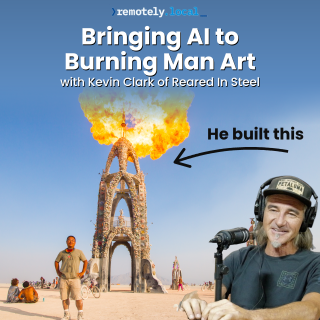
Ryo Koyama Hi, I'm Ryo Koyama. Welcome to Remotely Local, where we talk about everything physical AI. And today, Mike Johnson and I are very pleased to talk to Kevin Clark. If you have ever been to Burning Man, you may not have seen Kevin walk around, but you've undoubtedly seen a lot of his artwork. A lot of his artwork is the big sculptures that are flame blowing. A lot of the technology itself is actually tied directly to a lot of the real AI and technology things that are happening in the world today. So, welcome, Kevin.
Download transcript (.vtt)
0:04
0:32
0:33
0:47
1:00
1:09
1:37
1:49
2:08
2:51
3:52
3:52
5:21
5:46
7:04
7:21
8:20
8:23
8:30
10:30
10:50
10:50
11:53
11:53
12:25
12:26
12:51
13:19
15:42
16:13
17:49
18:02
21:42
21:42
21:43
21:45
22:44
22:45
22:57
22:58
23:00
23:09
23:21
23:39
25:40
26:38
28:09
29:15
29:59
30:27
30:28
31:08
31:09
31:54
31:54
32:14
32:18
32:52
34:13
34:26
34:26
34:42
35:00
35:15
36:32
36:49
36:49
37:04
Kevin Clark Thank you.
Ryo Koyama Now, you and Mike... for those that don't know, Mike and I have actually known each other since our first jobs out of college, but I think Mike and Kevin have been predestined to be friends. So, talk a little bit about your guys' lineage, history, and how you were destined to get together here.
Kevin Clark Yeah. Well, Mike and I pretty much met in high school, and our parents actually went to grade school together, Coleman School in San Rafael, and so, yeah, we were pretty much destined to be friends.
Ryo Koyama Okay. So, the name Reared In Steel. So, I assume that just like Mike, you are inspired by Ayn Rand. So, talk a little bit about the name, I guess, how that all came about.
Kevin Clark So, [laughter] yeah. Well, Mike was... [clears throat] we were trying to come up with a name for the company, and Mike was over here and we were discussing it, and we started talking about Ayn Rand's book, and he brought up Rearden Steel, and my partner at the time, she said "Reared In Steel," and, you know, it pretty much stuck from there. We're like, oh yeah, that's cool. It was a play on the name, a play on the words of the name. And so, yeah.
Mike Johnson Yeah. It's not like Hank Rearden, it's like reared in steel. Like raised in steel. So that was the play, right? And the good thing about it, I was on my phone: oh, we can get that domain name, we can do it, you know, all that stuff.
Ryo Koyama No, I think it's actually the most awesome and perfect name. And obviously anybody who has at least an affinity for [Ayn Rand] would see that, and I think it's kind of clever. Now, let's talk a little bit about what Reared In Steel is, because it's very, very appropriate. So talk a little bit about what you guys do here and, you know, I guess some of the things that you've been doing.
Kevin Clark It pretty much started in 2013. I decided to go back to build at Burning Man, and I really wanted to concentrate on my art, and I really wanted to do big art at Burning Man. In 2013 I went back, I built a carriage on these six-foot steel wheels that I lived in. Then the next year, in 2014, we built a Rhino art car so we'd have something to drive around. And then 2015 was my first major big art project on the playa, you know. Then we went on to build the Flower Tower after that, and the Fire Cathedral. Did a couple lions on podiums in 2016.
Ryo Koyama Well, let's back up, because one of the things I think is most interesting is you're sort of one of the OGs of building out, I guess, temples. I'm not a Burning Man person, but talk a little bit about what temples are, what Burning Man is, and kind of how you were involved in that early on.
[laughter]
Kevin Clark Yeah, it was early 2000s. I had just opened up a retail store, building furniture and selling art and doing whatever I could in the retail market. We opened up in the Landmark building in Petaluma, next to a place called Heebe Jeebe. I befriended this guy there named Jack Haye. He went to Burning Man with David Best and they built a temple. I think it was in '98 or '98, I think it was. He started talking to me: "Yeah, we're going to go back to Burning Man and build this big wooden structure and then burn it." And I'm like, what? That's like the stupidest thing. You're going to build it up? You're going to take all this time and build it and burn it? I'm like, I'm in. I'm like, I've got to see this. And so, you know, I volunteered my time. And at that time, it was Jack Haye and David Best. And they started the temple movement. Basically, that was my introduction to Burning Man. I never even knew a world like that existed. My mind was just blown. And I was like, "Wow, this is really cool." And back then it was like 20,000 people. The playa was dark and there were a few art cars rolling around, you know. Now it's like Disneyland. But I was just amazed at the scale, the interactivity, all the people that were volunteering, the logistics of a big project like that. I was just like, how do you do that? Then life got in the way, kids and marriage, and I was away from Burning Man, and I just had a desire. I kept in contact with all of my friends that were going to Burning Man, and David Best went on to build many temples. I think he's on like nine or so. Jack ended up going to work for Burning Man, and he worked on the Man base there. So I was really involved with them, but not participating in Burning Man, and with the desire that, you know, I wanted to build something there. I just didn't have the resources or the knowledge until later on in life. 2013 is when I committed.
Ryo Koyama So talk a little bit about that, because, again, Reared In Steel implies that obviously it's steel-based. Just from the description, people have a sense of the magnitude, but these are very large structures. Talk a little bit about how big they are, what your objective is, because I think part of it is obviously the size and scale that make it unique in terms of what its purpose is.
Kevin Clark Burning Man is large. On a scale of things, you're out in the middle of nowhere. Something that's 20 foot tall is barely visible. I mean, there's nothing around it to give you scale. And so, you know, building big is, I think, important, because it really sets you apart from the rest of the stuff that's out there. Medusa was 20, 30 feet tall, maybe, and about 50 feet wide. It has 26 snakes that shoot fire. Then the Flower Tower, it's 80 feet tall. It has 24, 26 fire effects on it. One of them is a large bomb, we call it, that goes off at the top. It can be a 50, 60-foot cloud of fire that comes out the top. It's a pretty shocking explosion of fire. It's really amazing, and even today I do it a lot at other festivals. The Flower Tower travels around quite a bit, and every time it goes off, no matter how many times it's gone off during the night, people are screaming, "Ahh!"
Ryo Koyama So Mike, just jumping in. Obviously you've been helping Kevin a little bit from the technology side of things. So have you seen that evolve? You had the internet, smartphones, things coming into place. Now we have AI. How do you guys see the evolution with these kinds of pieces, and how it's merging toward that space?
Mike Johnson It all started in 2016 when the first Medusa went out there. I was not involved except at the very end, on the technology piece that was integrated into the project, and it was more like a Rube Goldberg device. And then when we relaunched the Medusa, we designed a new system, very simple, very modular, so that we could use it in every other project that came after that. And it's based on a Raspberry Pi driving a bunch of relays, and we started building on that project. We're just starting to use AI in that technology piece, but I think what's really interesting is the evolution. The second time we had the Medusa on the playa, we had the new piece and it worked great. And then we had the Flower Tower, also based on that technology to drive the flame effects, and that worked relatively well. Your first time, right?
Kevin Clark Yeah. Right off the bat, it worked really well. Yeah.
Mike Johnson And then we evolved the technology, right, for your 2019 project, the Fire Cathedral. Why don't you talk about that?
Kevin Clark That one went... so like I said, I think we started the first year with Medusa. We put physical buttons on, and it was really, really nice, but after about five minutes you get tired of pushing the buttons, and you get the next person in there, and they get tired of pushing the buttons. And that's where it evolved into, okay, let's do something where we don't have to do this. Let's program this thing to run for as long as we want it to run. And that's where it came in, in 2016. We redid the whole electrical system for the Medusa and started with the Raspberry Pi and the relays. And then the Flower Tower, it worked flawlessly. Worked perfect. Then I had this crazy idea of building the Fire Cathedral. We ended up with 110 fire effects on that one. We wanted to program it. We wanted to program it to music, and MIDI just kind of evolved into what we used. So we use a MIDI keyboard. You can play the fire from the keyboard. You can program it. And the idea was really to lay some music tracks down and then lay some fire over the top of it. One of the issues that we have is that, you know, the keyboard is great, but if you're playing a song, you're hitting one, two keys at a time out of 110. And the visual of that is not as spectacular as you would think. So we wanted to make it more visual. So that's actually where we're at right now, being able to program it visually, and through the MIDI, because we have some effects for the Fire Cathedral that are super awesome. We have that progressive burn where the whole thing looks like it starts here and kind of explodes out the top, and that's super impressive.
Mike Johnson Yeah. And I think the other thing, just from the interactive side... Burning Man loves interactivity, people that have interactive projects, and we'll get to it later about why Guma and Love Pod Forest were such great projects. I thought, and I think, Kevin, you too, right, is that when the guy came, he was just walking across the playa and he had a keytar.
Kevin Clark Yeah.
Mike Johnson And he went up on stage and he just plugged in the MIDI and he was playing the fire organ. It was like one of those moments, like, we didn't think that would happen. It was just this random thing. This guy came up, and I think we invited him to some of the festivals.
[laughter]
Kevin Clark He came and visited us at one of the other festivals. But really, we were just setting up, and he came by and started talking to us, and we were telling him you can control it through MIDI, and he's like, "Oh, really?" He's like, "You know, I made this keytar. Can I play it?" And I'm like, "Yeah, sure, come on, bring it in," you know. So the funny part about that is that he just made that thing like the week before. He had no idea that we were going to be there. He'd never played in front of anybody or anything before, but he gets up there on the stage, and there just happens to be a woman there who has flaming roller skates. So we put him up on stage with this keytar, and we had this girl with flaming roller skates going around, and he's playing this keytar on the Fire Cathedral at Burning Man, and it was just amazing. I mean, that really was a moment for us, like, wow, okay, finally we did this to where it's really interactive, and it was really amazing. Then the other thing is, we had another guy that year, a guy who was a pianist.
Mike Johnson Wally.
Kevin Clark Wally. Yeah. We set him up, and since we had the MIDI, we could change it. You could play the piano, you can play the keyboard and turn it into drums. You could do whatever you wanted. But we had him up there playing it like an organ. And it was really amazing. He was really good at doing that, too, and he's also come to some of the other festivals.
Ryo Koyama So, Kevin, I would consider you to be a true OG kind of artist. It's real hands-on, everything like that, but you have some very warm ideas about using AI in terms of how it works and everything. So talk a little bit about how you view AI in the space, because in a lot of ways AI is portrayed very much as the villain, especially around artwork, and people are curating so much stuff, which I think is true, but at the same time you see that there's a balance that can be had.
Kevin Clark Yeah. Well, certainly I think AI is here to stay, right? It's going to be something that we are going to be dealing with for the rest of our lives and probably forever, right? You know, I encourage my kids to use AI, and they're still kind of anti-AI. And I'm like, look, you can use AI as a tool. Don't use AI as your end result or your artwork. You're not claiming AI to be your artwork. You're using it as a tool to get to your artwork and to make it faster. So, like for me, coming up with an idea that I'm proposing for a project, doing an AI image real quick just to get interest is a no-brainer. It's quick, it's easy, it gives me an idea, and, you know, I know how to build. So, I can make AI create an image that suits what I'm thinking about building. And, you know, I was trying to tell my son, he writes music. He writes it all by hand. And I'm like, you know, you need to embrace AI. He says, oh, no, I don't want to use AI. And I'm like, just use it as a tool. Tell AI what your idea is. Have it write out the track, and you can go in and change it to whatever you want. You're not claiming that it's AI, because you're going in and changing it. It's just a tool to help you get to what you want quicker. And it's the same with any of this: drawing, sketches, imagery, anything. I think AI is definitely here as a tool, and people just need to figure out how to use it. I mean, people who think that AI is the end result... it's not. It's the in-between. So even though I'm hands-on, and most of my stuff has been completely physical, meaning I do a hand drawing, I do a hand model, which I love doing, but it takes up a tremendous amount of time. So I would use AI for an image, and then I would still go through and make a model after that, because then it's really coming into reality. So yeah, AI as a tool, I think, is the greatest thing. People just need to embrace it in that way.
Mike Johnson And I can say, I've been hanging out with Kevin in this warehouse here all the time, and I would see the effort he would put in just for a sketch, just to send out to get interest, right? It might be a week or half a week, because he's a perfectionist. But if he can describe it and have it generated, and he can iterate on that, he could do that in 15 minutes. He doesn't know if someone's going to want the project or not, right? So why invest a whole week or half a week, when some of those drawings you do are just... crazy.
Ryo Koyama Well, I think that's going to be the key. I saw this viral clip that went around where there was a student who basically said, "There is no way that people used to write papers that were 10 pages long without AI." And it was daunting. I was like, "Oh my, we've hit a tipping point." And I think you're sort of touching on that, because we're in an interesting situation where people think it's the end result. But I like the way you describe it as a tool, because we are seeing it. I think it's very fascinating. We have a whole younger generation now who is embracing things like cassette tapes. What I think is most joyous, or most unique for everybody, is feeling this sense of uniqueness. We touched on this a little bit before, but I think we're hitting a weird period of time where everything is way too homogeneous. And I think it was happening before AI; AI is accelerating it. What I think is interesting is when you go out and do these things, you're obviously creating something unique, something from your imagination. You're trying to invoke a certain feeling. So what do you think the challenges are going to be? You talked about interactivity. So let's talk a little bit about some of your more recent things that are embracing a lot more technology to make it interactive, because I love the story about people coming on stage and all of a sudden plugging in. I always say the best things in life are unexpected, and what you want to do is create an environment where magic can happen, and to me that was a magic moment. So talk a little bit about how it's going interactive, how you're using technology, and maybe creating a better platform for that sort of spontaneity.
Kevin Clark You know, my last piece was with my daughter, which was Guma. We didn't use any AI or anything on that one. But the interactivity was amazing, you know, climbing all over it.
Ryo Koyama So let's give it a little bit of a backdrop, because I had a chance to see it when I walked through there. So what is Guma, and what was the inspiration? Talk about exactly what it is.
[laughter]
Kevin Clark So Guma was... I started talking with my daughter, who was in high school. We started talking, she's been to build week at Burning Man a few times with me. Burning Man itself was a really difficult thing because she's got school, and so she's been to a couple of my builds on playa. I started talking to her about, you know, let's do a piece at Burning Man. You're an artist. This is a great platform. You have an opportunity, a shop, anything. We can build anything. So at first she was a little timid about it, and the scale of things was a little small. She's like, "I'm thinking like 20 feet tall." And I'm like, "No, you can't do 20 feet tall. You won't even be able to see it." [laughter] I said, "You've got to think bigger." And so we started talking about many things. And for Father's Day, she made these... she's always making people presents. And so she made this little clay figure, and actually she made three of them that represented me, her, and my son. And so we started talking about stuff, and we started to come up with a project, and we started talking about this little clay piece and scale, and then she decided, well, this would be a good project. I agreed, because the interactivity of it is, hey, we can make it big enough to climb over the top, you can climb inside, you know. Yeah. Okay. So then I'm like, okay, let's lay this out in scale, one inch per foot. Make me a drawing of this piece. And we laid out a big piece of paper here and she drew it, and it was about 80 inches long, you know, and I'm like, okay. Yeah, that works. And so we went ahead and built that, and it was basically her directing her ideas, and my team put it together and built it. But in the meantime, we also took some of the high schoolers. We were teaching welding to the kids, and once or twice a week during the summer we would have a couple hours where we would teach them how to weld, and they always seemed to want to weld weapons. [laughter] If you let them go, they just all seem to gravitate towards swords and space guns. Anyway, we took a few teenagers out to Burning Man last year with this project, and it was our first honorarium grant from Burning Man. It was really, really exciting. Really, really interactive, much more interactive than I even anticipated. Being able to walk over the top of it and down the other side, being able to climb inside, being able to hang out underneath. And the scale of it was perfect for Burning Man. It did have a small piece of tech in it, and it was just the lighting. The lighting was beautiful. At night you could see that thing from a mile away. You could see the Guma. In fact, it was a good anchor: you'd get lost out on the playa and you could see the Guma, and our camp was right down the street from Guma. So, yeah, we did get a viral video of somebody's unfortunate accident off of there, where somebody thought they were smart enough to ride a bike down the tail of it. And
Mike Johnson That didn't work out well.
Kevin Clark No, he face-planted and knocked himself out. And the funny part about that is that I didn't know what happened. And of course, we've got to go out there and check on the piece every morning and turn off the generator for the lights. And so I went out there with a buddy of mine, and we roll up to Guma, and there's this bike. It didn't look like it was run over. It looked like somebody smashed it. And my buddy jumps out of the Ranger, and he jumps on the tire, and he bends the fork and takes off riding this bike back to camp. It went to camp, and camp mates stripped it. It wasn't until after Burning Man that we saw the video, and then I recognized the bike. I'm like, "Wait a minute, that's the bike Omar rode back to camp." And so actually the frame of the bike ended up here, what was left of it after.
Ryo Koyama Oh, that's awesome.
Kevin Clark And I've been trying to track down that guy. Of course, I'm not a real social media person, so we haven't had much luck, but I wanted to send him a t-shirt or something. [laughter]
Mike Johnson Definitely.
Ryo Koyama Well, that's awesome. We definitely have to make that.
Mike Johnson That video was just crazy, right? And of course you guys know that on social media, the remixes of it, there's just a million of them.
Ryo Koyama Oh, that's so funny. So what are the other projects? What are you looking at now? Going forward, obviously there's a lot going on and you've got more projects coming out. So what are you looking at going forward?
Kevin Clark We are working on perfecting the technology that we have, revamping all of the systems. We've upgraded the Raspberry Pi, which Mike can get into a little bit more, trying to make it more seamless, being able to... well, why don't you explain?
Mike Johnson Yeah, this whole system has evolved. We started with the Medusa, but when we did the Fire Cathedral, we used seven 16-channel relays on a USB bus. So it grew, right? And we also added the MIDI control, and we have these little, we call them brains... I wish Renu was here, because she's also really on the technology side of the projects. She's amazing. We have the Raspberry Pis, and we started with Raspberry Pi 3Bs, and they were underpowered and we were having all these latency problems, so we've upgraded to the Pi 5s. We're trying to add a little AI in it, so we could process music and turn it into effects. We do use a little bit of AI now to generate sequences based on parameters, and we can give it music and have it generate the files. They're all just text files of the sequences, but we're just starting to touch on the edge, right? So the Raspberry Pis are actually interesting, in that they also have Remote.it on them, and every once in a while it's saved these guys, because I'm not there, and if something goes wrong with the programming, they're basically screwed, right? So we have it set up so that they can turn on their phone hotspot, and the project automatically connects to the phone and phones home, and I can get on there and, oh yeah, we'll straighten this out or fix this or whatever the case may be. It's more of a Renu thing, but, you know, I get Kevin: "Ah, we've got problems!" [laughter] "We've got 15,000 gallons of propane we need to shoot off and we're having problems." So, you know, get on there and fix it. So it's kind of the technology integration, and I'm hoping that with the new effort at Remote.it with the MCP interface, we can also leverage that to help program these devices and link them and do other interesting things, right?
Ryo Koyama No, I think that's great. From a technology perspective, one of the things I love about AI is that, you know, Mike talked about an MCP interface. That's sort of like the universal interface, but I think it allows people to speak regular language and get their ideas into reality. And one of the things I love, Kevin, that you talked about is that you're teaching a lot of kids on the welding side. And I think it's interesting because on one flavor, everybody's like, everybody's got to learn AI. And I think there's some truth to that in terms of being able to empower yourself to utilize it, like you talked about with your kids. But on the other side, if you want to really enable the physical part of AI, I think you have to have some fundamental physical skills, like welding and everything like that. Talk a little bit about that, because we were talking about it before, but I think a lot of the younger generation is looking to get much more hands-on. So what have you seen about that? And do you draw a lot of inspiration when you see that desire come out?
Kevin Clark Yeah. It's really interesting to see these kids getting interested in welding or doing something hands-on, in a time where it seems like there's nobody that wants to do it. Like, you hear all the time there's nobody in the trades, there's nobody doing this. But on my side, I hear all the time, "I want to learn how to weld." I don't know if it's because they see what I'm doing and get inspired... some people have come back to me and said, "Because of the Flower Tower, because of this, I learned how to weld." And so it was an important piece in my daughter's project that we teach some kids how to weld. And when I say teach them how to weld, I mean, there's no theory. I'm like, this is a MIG gun, and this is how you do it, and just go. [laughter] So I would just spend a few minutes with them and then just let them go. And we taught them how to use the plasma cutter, and they were all just super excited. We would talk about, okay, let's come up with a small little project. Let's cut something. Let's weld it together. Let's get some shape to it. And it was great to see these guys come up with their ideas and what they wanted to do. And I think it inspires them to go out and do more.
Ryo Koyama No, I think that's great. Everybody talks about the evils of social media, and I think there's a lot of truth in that. But there are two things that you hit on that I think were really interesting to me. Both my daughters are reasonably successful on social, and one of them once told me, "It's the people that don't react that you've actually impacted." And so I love the fact that people come up to you and say, "Hey, I saw this and it inspired me to do that," because I think that's number one. It's very true. Whereas in some flavor, everybody's chasing the likes. The likes don't matter. It's who you actually touched that really mattered. The other side of it, though, is on social, I see all kinds of people building stuff and doing all sorts of things, and a lot of them are younger, and they're saying, "Hey, I want to learn to do this. I'm going to show you my journey," and they're going to show you the struggle. And what I loved about what you said about teaching them is you didn't sit there and say, "Here's what you have to do. Here's the instruction manual." You said, "Here it is. Jump into the deep end of the pool." And I think that's how a lot of people practically will learn these things, and I think those things really, really matter.
Kevin Clark Well, I mean, that's basically how I learned. I didn't take any formal training. I took a high school shop class, which was an introduction to welding in, like, a two-week span. I got to stick weld two pieces of metal together. But I was always... my stepfather was a cabinet maker, so I was introduced to that. I did a lot of woodwork, so I've got a very well-rounded building background. But metal, welding, kind of built itself and didn't really show its face until later on. Life before that was different, but—
Mike Johnson But the delta is... so Kevin talks about high school welding. I was in that class with Kevin, actually. We had Mr. Adams, and we got to play with the forge and burn stuff and use the stick welder, and we learned all that stuff, right? That doesn't exist today anymore, right? And it's great that when Kevin had these kids, I remember they were excited, because that was an opportunity that really doesn't exist for these kids anymore.
Kevin Clark Yeah.
Ryo Koyama Yeah. And I think, again, there's some beauty in social media, because some people are encouraged to do it, but in a lot of cases people are afraid, because they're like, "Well, I don't know anything about it. I don't want to embarrass myself." And I think embarrassment is probably an underexplored emotion in this case. You want to really try these things, and I think providing an environment that allows that to happen matters. Mike and I are involved in tech all the time. Everybody romanticizes tech: this person programmed this stuff, they did it on their own. And the irony is, it's even more true for all these other pieces, because none of those things are going away.
Kevin Clark Yeah.
Ryo Koyama If you know how to run some electricity or connect different things, those things physically matter, and I think people are really losing touch with that. And I think that's why I like the idea of physical AI, because people have forgotten the physical part. What's happening in this whole space right now of physical AI is, you have OpenAI, you have Claude, they've solved that part, but they forget that there are billions of things in the world that can't talk to it, and there are going to be builders, there are going to be people who take these things and make them interface with that. And I think that's lost, and that's a big opportunity for a lot of people. And going further to what you talked about, there's that whole artistic side of things that's not textbook.
Kevin Clark Yeah.
Ryo Koyama So many great inventions come from inspiration that's orthogonal to what you're thinking about. And I think those are some of the big pieces that you're obviously touching on, and bringing that forward. So you're going to have to force yourself, Kevin, to be much more active, I think, on social, to get some of your ideas and your inspiration to the people.
Kevin Clark Yeah, it's going to be a tough one. I think I'll just have to find somebody to help me with that. [laughter]
Ryo Koyama I mean, yeah, but I think it's like, you know, I'm Japanese. In Japan, they're well known for people who are tradesmen in one particular discipline. And one of the things that's very challenging right now in Japan is that's going away, and they're talking about how that's going away. But I think figuring out how to leverage, like you said, how do you take advantage of the tools that are out there, whether it be social or AI. These are the instruments that are going to make sure some of these skills don't get lost. And I think those are going to be the important things, and people embracing that really matters in this space.
Kevin Clark So, like any of my projects, right? It's not built just by me, right? I have a whole team of people, and my projects are huge. If I was to go and build it by myself, it'd take years. And so I employ a lot of very good welders and other artistic people. And I think social media needs to be the same. I know what I'm good at. I'm not good at social media, and I don't want to pretend to be. I don't even want to try. I want somebody else who is actually good at it to go and do it. And that's part of me building a team, right? I've got an idea: this is what I want to build and this is how I want to build it. I need to find those people that can help me get to that idea. And social media and AI are the same. I use AI, but I'm not a professional at it. I'm just an amateur. Social media, I'm really bad. So for me, I think getting the right team member on my team who would promote more of the social media is key and important. Social media is important. How to get out there and be seen, you know? I don't know how I've made it this far. I don't even have a web page or barely any social media at all. I don't even have a business card, if they even do those anymore.
Ryo Koyama Well, it makes sense. And I like the way you describe it, because really what we're hitting is different plateaus of baseline. What I like is the way you said it: right now so many people are fixated on "I've got to be perfect at everything."
Kevin Clark Yeah.
Ryo Koyama And that is not reality. So find the people that are good at what they do, and then grow from there and grow all that out. All right, I always like to wrap things up with a hot take. So what is your hot take on where everything is going with AI and all this space?
Kevin Clark Wow. I mean, that's a big topic. That's a big ask, too. Yeah. I mean, I don't know. I think we're waiting to see where our robot helpers can come in to start helping us, and I'm looking forward to having some of those guys weld for me. [laughter]
Ryo Koyama Well, that's interesting. That's a fascinating thing, because I would imagine people have talked about that. When you mentioned that, I found it quite interesting, because you're like, hey, I'd love to have a bunch of robots doing that thing. So is that what you can start seeing?
Kevin Clark I would like to, yeah. They have robot welders now, not in the sense of walking, talking types, but robotic arms doing the same movements over and over again, type welding. I've seen different evolutions of that. It would be amazing to see literally robots walking around that you could program: okay, do this, and when you wake up in the morning, it's done. Again, finding ways to use that technology to do what I do is going to be key. Like I said, using AI as a tool, any of it needs to be used as a tool. And I think we're on this journey to figure out how AI is going to fit in the world and how people are going to embrace and use it. And it is infinite right now, those possibilities. And I just think most people cannot see past the evil AI and what it can be used for. And I think that it can be used for good. We just need to figure out how to use it.
Ryo Koyama I think that's well said. To your point, it's very easy to see the dark side quickly. And again, often the most beautiful things are unexpected, because no one's planning for it. It's kind of like the guy showing up with whatever it was, that keyboard instrument.
Kevin Clark Keytar.
Ryo Koyama It was unexpected, and it's magic. I think those things are magic. So, well, Kevin, thank you so much. Loved this. And you know what? We're going to make sure we document your next project and show the evolution of that, because that would be an awesome thing to see.
Kevin Clark Yeah. Great.